Saturday, May 29, 2010

The Pied Piper of Hameln

HAMELN


Still no luck with the weather, cloudy and cold but we ventured out for our day in Hameln. Hameln is famous for the story of the Pied Piper but as we learned on our tour, it was also an important trade/mercantile center. This brought wealth to some of its citizens and they built very ornate houses, especially during the period of the Renaissance. This city being on the Weser River the houses were called as built in the "Weser Renaissance" style. See some examples.


Of course we all had to take a picture of another great "Weser Renaissance" building.. McDonalds!!


First, we took a leisurely boat ride on the Weser River. Nice time to chat with each other, enjoy a warm drink and take pictures of the passing scenery. After the boat ride, we were met by our tour guide who led us around Hameln and gave us the history of this famous town.


In case you don’t remember the story of the Pied Piper, here is the Brother’s Grimm version:

The Children of Hameln
Jacob and Wilhelm Grimm


In the year 1284 a mysterious man appeared in Hameln. He was wearing a coat of many colored, bright cloth, for which reason he was called the Pied Piper. He claimed to be a rat catcher, and he promised that for a certain sum that he would rid the city of all mice and rats. The citizens struck a deal, promising him a certain price. The rat catcher then took a small fife from his pocket and began to blow on it. Rats and mice immediately came from every house and gathered around him. When he thought that he had them all he led them to the River Weser where he pulled up his clothes and walked into the water. The animals all followed him, fell in, and drowned.
Now that the citizens had been freed of their plague, they regretted having promised so much money, and, using all kinds of excuses, they refused to pay him. Finally he went away, bitter and angry. He returned on June 26, Saint John's and Saint Paul's Day, early in the morning at seven o'clock (others say it was at noon), now dressed in a hunter's costume, with a dreadful look on his face and wearing a strange red hat. He sounded his fife in the streets, but this time it wasn't rats and mice that came to him, but rather children: a great number of boys and girls from their fourth year on. Among them was the mayor's grown daughter. The swarm followed him, and he led them into a mountain, where he disappeared with them.
All this was seen by a babysitter who, carrying a child in her arms, had followed them from a distance, but had then turned around and carried the news back to the town. The anxious parents ran in droves to the town gates seeking their children. The mothers cried out and sobbed pitifully. Within the hour messengers were sent everywhere by water and by land inquiring if the children -- or any of them -- had been seen, but it was all for naught.
In total, one hundred thirty were lost. Two, as some say, had lagged behind and came back. One of them was blind and the other mute. The blind one was not able to point out the place, but was able to tell how they had followed the piper. The mute one was able to point out the place, although he [or she] had heard nothing. One little boy in shirtsleeves had gone along with the others, but had turned back to fetch his jacket and thus escaped the tragedy, for when he returned, the others had already disappeared into a cave within a hill. This cave is still shown.
Until the middle of the eighteenth century, and probably still today, the street through which the children were led out to the town gate was called the bunge-lose (drumless, soundless, quiet) street, because no dancing or music was allowed there. Indeed, when a bridal procession on its way to church crossed this street, the musicians would have to stop playing. The mountain near Hameln where the the children disappeared is called Poppenberg. Two stone monuments in the form of crosses have been erected there, one on the left side and one on the right. Some say that the children were led into a cave, and that they came out again in Transylvania.
The citizens of Hameln recorded this event in their town register, and they came to date all their proclamations according to the years and days since the loss of their children.
According to Seyfried the 22nd rather than the 26th of June was entered into the town register.
The following lines were inscribed on the town hall:
In the year 1284 after the birth of ChristFrom Hameln were led awayOne hundred thirty children, born at this placeLed away by a piper into a mountain.
And on the new gate was inscribed: Centum ter denos cum magus ab urbe puellosduxerat ante annos CCLXXII condita porta fuit.
[This gate was built 272 years after the magician led the 130 children from the city.]
Here is a link to the Wikipedia story with possible theories of what really happened.

http://en.wikipedia.org/wiki/Pied_Piper_of_Hamelin

Well, we decided that the Piper still has power today, as we were following our tour guide through the town we came face to face with the Pied Piper leading another tour and playing his fife and we lost half our group following him instead of our guide. We caught them in time before they were lost.

Fun day!

Friday, May 28, 2010

Detmold Living History Museum


Tuesday - Detmold Freilichtmuseum

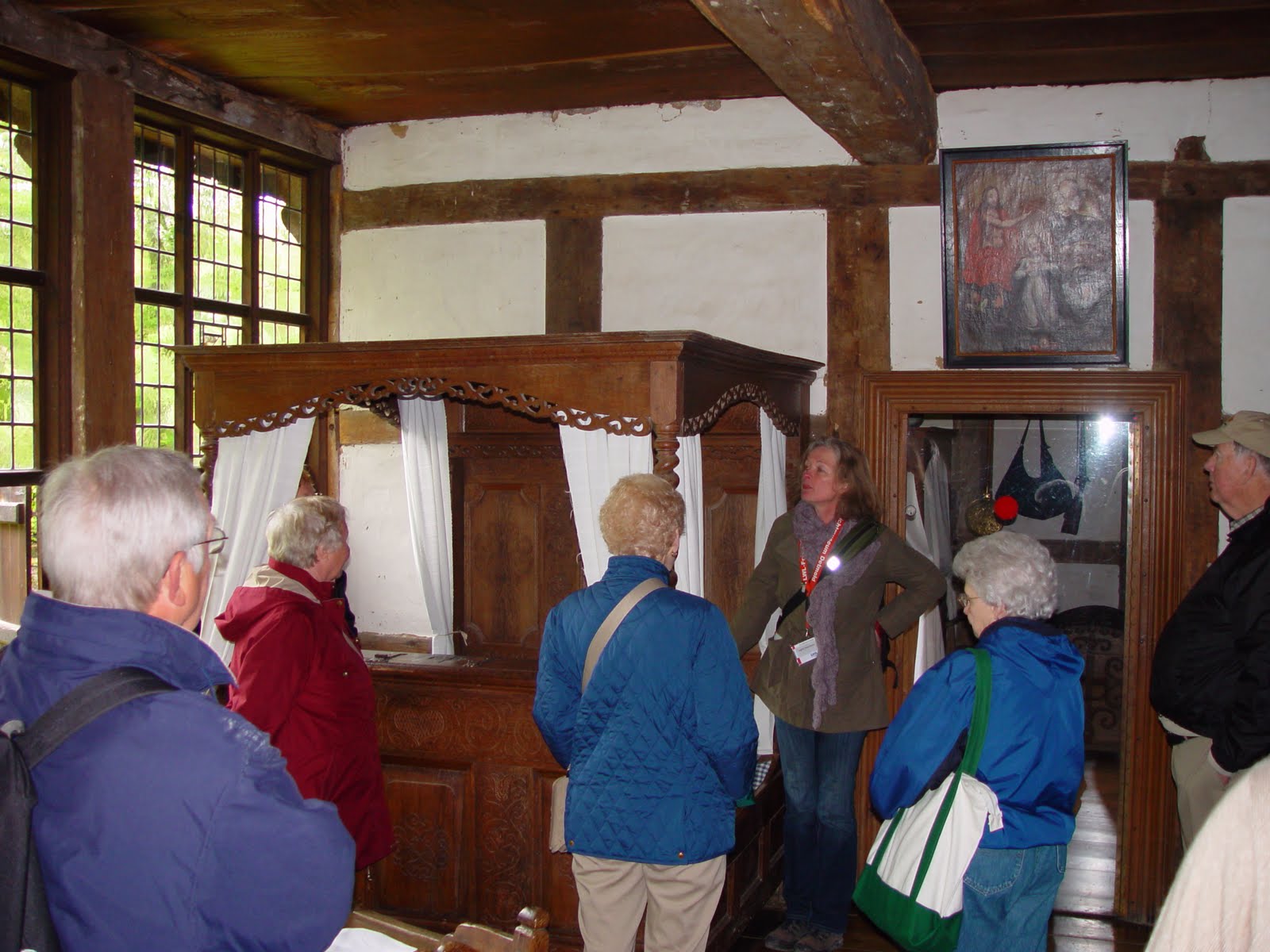
One of my favorite places to visit when we are in the Northwest of Germany is the Freilichtmsueum (living history museum) in Detmold. It really helps to give you a first hand look at how your ancestors lived centuries ago. Although a lot of the farm houses were large, probably more examples of landlord houses, they do have a couple “heuerlinge” houses, where the poor tenant farmers lived. I’ve requested the same guide the past couple times because she is so good, her name is Ingrid and she is very knowledgeable about the museum and also of the time periods. She explained a few interesting things that you may not have heard before.
One is when we were visiting in a bedroom of one of the larger landlord houses, she showed us on the bed where there was built in little cabinets at the foot of the bed. This is where the farmer kept his valuable possessions, especially if there was any money. This allowed him to know where it was even when he slept and they still have a saying in Germany about this.
“Geld auf der hohen Kante haben” to have some money put away. Or for rich people they say
“Geld an den Füßen haben” to have money at the foot.

Another interesting thing she told us was when we were out in one of the gardens. Still today they grow things in the gardens that would have been needed on a working farm but we noticed a little shed out past the gardens and asked what that was used for and Ingrid told us that when the farm wife would do the laundry (which we found out wasn’t very often) they would spread the linens out in the field to dry, plus they needed the sun to bleach the linen whiter, someone would need to stay in this house night and day to keep an eye on the linens, so they wouldn’t blow away or get stolen. Linen production was a major industry in this part of Germany and most farms used this as additional income in the winter time to supplement their farm income. Most income or production was taxed by the landlord too.

One other thing she told us what about another saying they have in Germany and how it may have got started. The saying is.. “ins Fettnäpfchen treten” Explanation:

In the farmhouses we saw hanging above the fireplace the sausages or other meats that would be smoked from the smoke rising from the fireplace and of course since the majority of these meats was fat, there would be grease or fat falling to the floor. At night or even during the day in the dimly lit house, you would have to be careful not to step in the fat and drag that along the rest of the floor. Sometimes they would put small pots or buckets to catch the fat and now this saying means something like “to blunder or put your foot in your mouth”
These were a few of the interesting stories we learned this day. I will include some pictures and a couple short videos of Ingrid’s talk.


After the Freilichmuseum we headed into Detmold to the Landesarchiv. We had called ahead of time and had things pulled for any of our tour members who would have had towns that would be covered by this Archive. First we had a short overview of the Archives by one of the employees and he was very interesting. He explained the types of things they had there and how they preserve items. My main question to this man was “How can we find out what exactly is available at this archive?” Well, unfortunately they have so much stuff it is not possible to have a complete online catalog. So the best advice I can give you that he gave me is if you know your hometown and know the closest Archive, you can email them with your town’s name and ask what they have for this town. You may be surprised. A couple of our tour members found out that they had pulled for them the complete Farm Books for some of the Farms that their ancestors had lived on. They were able to request that these books or however many pages they wanted be imaged and sent to them on a CD. Then they can get them translated. I assume that most of the information would be tax lists, or maybe even deaths and who would have next run the farm but we will have to see what all kinds of detail is included in these books. What a find though. So I guess it pays to check with the Archives and see what is available for your town.

Then we walked through the main pedestrian zone of Detmold and wandered through the Gardens of the Residence Palace of the Prince of Detmold-Lippe. The Princely Family with Armin Prince zu Lippe as the head of the family, still lives in this palace. After a little while to shop or take pictures we headed to a local restaurant for dinner.


Thursday, May 20, 2010

Visting German Ancestral Towns

What a week! Finally get a chance to start this blog. We have been busy from morning to night it seems and then it feels so good to snuggle into bed under the down comforter. Believe me we have needed the warm comforter, it has been cold here. The coldest May in over 200 years or 70 years depending on who you talk to here. But it didn’t stop us from our daily treks and having a good time. After settling in our hotel in our cute little spa town, some folks walked through town as it was festival weekend. Lots of craft stalls and music and after a little while we all met back at the hotel for dinner. We had an early start the next day, so we made it an early evening.

Monday was a free day and everyone headed out to visit their hometowns. I had 3 other couples traveling with me to visit in Dissen and Hoyel. Some of the other towns being visited that day was Brake, up near Bremen and Jollenbeck, near Bielefeld, Venne near Osnabrueck and Osterwick & Legden.

For our group going to Dissen we were met by a group in front of the Rathaus. The President of the Heimat museum, the President of the Register office and some English translators and a wonderful storyteller, Herr Brandt. More about him later. They had a schedule worked out for us and they whisked Myrna Weiland away to show her where her ancestor’s house was, it was a heuerlinge house which was near the Rathaus which had been the farmers house and now is the Rathaus. Then off we went to my hometown of Bockhorst again. I had sent them my information because the last time I was here I found out one of my ancestors came from Dissen but they had thought I wanted to visit Bockhorst. Oh well, it was nice to see my hometown again, I just hated taking up time from the others. After we visited my church in Bockhorst again, we headed back to Dissen and then went over to the St. Mauritius Evangelisch church in Dissen where our ancestors were baptised.married and buried from.


Dissen Church


We met a local researcher, who is one of the few people who has access to the church books, and were able to look at the church books for a little while. Myrna (tour member) was able to look at a few of the entries for her ancestors. See some pictures.


Then back to the heimat museum where they had set out a nice lunch for us there. Wonderful breads with cold cuts and a local specialty, griebenschmalz. We would call it a lard sandwich! I chose the liverwurst with sliced sweet pickles. I remember eating this a lot when I was a kid. We were served by a lady dressed in traditional dress for this region, in her Sunday best.


During lunch we were entertained by Herr Brandt, a retired teacher who had grown up in Dissen. He told us the story of his greatgrandfather who owned/managed the Emigrant Agency for this area. Later he showed us the house where this was located. When people decided to emigrate they would have to apply for emigration (many left without applying for this) and they had to buy their passage and get to the port city. We asked how they got the money for this and we were told of course they sold whatever they owned to get the passage. Herr Brandt thought the cost would be about $40.00 per person, plus to enter the U.S. you must have at least $20.00 or they would send you back. This return passage was on the shipping line so it was in their best interest to make sure the passengers had their $20.So in addition to the passage money, the emigrant would have to pay the agent the $20.00 which he would hold for them and give to the ship’s captain, who then would hold it for them until they reached the U.S. Too many temptations perhaps of gambling or whatever on the ship. Herr Brandt also told us that his gr-grandfather supplied passage by horse cart to the Weser River, where they would then take a boat to Bremerhaven. Just the start of a long journey to a new life.

After thanking our hosts for this wonderful morning we headed off to Hoyel and Melle.
First stop in Hoyel was the windmill. The President of the Windmill Society (who is also the mayor of Riemsloh) met us and opened up the windmill and museum for us to see. This was the mill for the town of Hoyel in former times and one of the many windmills on the Mühlen Strasse. Off to the church then. This small church is close to 400-500 years old, the current building, there was an older one on this site. This church has a
Model of Hoyel church
beautful blue ceiling and one of the more interesting things was the wooden pews have the names of members of the congregation who have paid for this honor carved into the pew. One of the members of our tour were lucky to see the pew that their ancestor had paid for the seat and they got to sit in the same spot!


(The name inscribed here is Backhaus) Ralph & Myrna


Then on our way to Melle, where we met the President of the Heimat Museum, a young man who showed us the heimat museum (historical museum) which had rooms of traditional costumes and rooms showing a kitchen and a bed room from older days and even some archelogical finds from the area of dinosaur bones. There were several buildings of this museum and set in a beautiful setting. The young man, Uwe, was very knowledgeable and we could tell he was proud to show us the

historical remants of his city’s past. We enjoyed it. He showed us outside some of the old, old, Border stones which had an H on one side for Hannover and a P on the other for Prussia. These were used to mark the territory of these 2 former regions.


Then we had dinner in a half-timbered house on the museum grounds and it was late when we got back to the hotel. But a very successful and interesting day.
P.S. Other folks on the trip also had good days visiting their hometowns. Meeting cousins, getting more generations back and walking the homes and churches of their ancestors. All in all a very successful day.

Tuesday, May 4, 2010

Leaving for Germany

Only 2 more days until we leave for Germany. We will be traveling to the Northwest area and have lots of interesting people to meet and incredible places to see. I will be sharing our adventures soon.

Saturday, March 20, 2010

Traditional Dress in Germany


One of the things I like to include on our Heritage trips is a visit to a local history museum, or a Heimatmuseum, as they are called in Germany. Here you get to see articles of the past that were used in that town or region and help you to picture what your ancestors life was like, sometimes these include traditional dress too. I would like to talk a little about folk dressing in Germany and include some pictures from some of these museums we have been to.

The traditional or folk costumes of the Germans have been studied extensively. Regional or folk costume did not exist in the Middle Ages. Workers on small bits of land were subjects of a landlord or some sort of overlord. There was little time for weaving and construction of even the simplest garments. Dress of the working people was usually made at home of home grown linen or wool from their flocks and was sturdy enough to last a lifetime.

Throughout Europe during this time men wore a simple tunic and short breeches held up by a strip of leather or other material threaded through the top of the garment. Early Germans wore long straight trews or trouser with notched (dagged) edges to prevent them from fraying. Sometimes strips of fabric bound the trousers to the legs,calf or ankles. For winter a short cloak was added.

Women's dress was made from two straight pieces of fabric sewn without shoulder or waistline seams. A girdle held in this long, simple gown at the waistline. The lower portion of the gown was often drawn up or looped over the girdle to facilitate working in the fields or household. Extra warmth was provided by a simple cloak draped over the head and pulled around the body. Hats woven of straw were worn by both men and women during the summer to protect them from the sun.

Costume of the upper classes and wealthy tradesmen tended to be of a more elaborate international style. The middle classes in the towns developed a dress of a distinct form from that of royalty and the nobility and from that worn by the working men and women.

Traditional regional folk costumes are not very old. They start to develop from the fashions of the late middle ages. There seemed to be little regional dress in the fifteenth & sixteenth centuries. Probably this was a result of constant wars and invasions. Materials, however, were regional with more woolen garments in some countries coarse linen in others. Colors varied according to the plants which were grown locally for dyes.

In the 17th century the first signs of regional dress appeared as well as differences in clothing of the wealthy farmer and the poorer laborers. Elaborateness of dress in the different regions depended in part upon the prosperity of the region. Rural populations usually were clad in clothes which were made in their own area. The small town tailor usually did not keep pace with more rapid changes affecting the towns. Albert Reinhardt in his book, TRADITIONAL COSTUMES IN THE BLACK FOREST, p.16, observed that it probably "against the grain of countrymen that something is loved today and abandoned tomorrow." As the modern European nations came into existence, a regional dress also preserved the identification rural folk have with a particular spot of land. Once a primary form was established, certain elements of the current fashion were often incorporated into the style of a particular region.

These regional costumes hardly survive at the present time in Western Europe unless they are used as an attraction for tourists or preserved to wear during local festivals. Many individuals traveling to the area where their family originated may be able to find pieces of these regional costumes. In some places you can find a tailor or seamstress who will make one for you. These are worn with pride for special occasions in the U.S.A.


Red Pom-Poms on a straw hat in the Black Forest means Unmarried woman. Black pom-Poms designate married women.

Other dresses for special occasions in the Black Forest.


These dresses are from the Northwest of Germany, a museum in the town of Rahden.


A Farmer's wife outfit and a Sunday outfit and baby's christening Dress


Linen undergarments from the Northwest Germany and a farm wife's collection of "linens" The Northwest of Germany, Westphalia and Niedersachsen were big linen weaving areas.


These museums are a wonderful way to "picture" what your ancestor looked like.

Sunday, February 21, 2010

Northwest Germany 2010

Wow, where has the time gone! Already end of February but things are pretty well planned out for our Germany trip in May and I am so excited! I love when we start making the contacts in tour members hometowns, it is always so interesting to me who and what will happen. Right now some of the contacts we have made is a Town Archivist from the city of Bielefeld, she will meet our travelers at the train station and drive them to their home town of Jollenbeck. There they will visit the town museum and walk through the church and their guide will tell them the history of the emigrants from the area. We are hoping that this lady will also meet our group to give us a lecture on emigration from this area, as she is writing a book on this subject.

We also have another town archivist, who is also an avid family researcher and emigrant specialist who will meet another pair at the train station and take them to visit their hometown of Osterwick. He is preparing a family tree for them and is looking for some cousins still living in the town.

Another town one of our tour members calls home is Quackenbrück, which is celebrating its 775th anniversary and is sure to have some kind of festivals going on. This town is also home to more half-timbered homes than any other town between the North Sea and Münsterland. Someone will meet our travelers again and take them to the town museum and to visit their ancestral hometown. Our tour members have some beautiful mementos that were brought from the Old Country to America that they would now like to donate to the town museum. Should be an interesting day.

We have more towns and more exciting meetings, some German cousins have also been found, and visits to farms which are still standing and being used hundreds of years later, maps found in Archives of cemeteries and who was buried there for several hundred years (this is special as you know German graves are re-used after 30 years). Add to this some of our group activities, such as our tour of an Open Air Freilichtmuseum in Detmold. Here over many acres we will see what types of homes, farms and trade shops our ancestors lived and worked in. I've had a great English speaking guide named Ingrid the past couple years and she adds a lot to learning how they lived in these buildings and how the social customs added to reasons they might have had to emigrate.

Then we also see how they left, by visiting the Emigrant Museum in Bremerhaven. This fantastic museum in on the quay leading out to the North Sea and shows us how the unknown journey was experienced by thousands of emigrants to New Worlds. You walk through the doors of the 21st century and enter back in time to the processing room of the early 19th century. See the hull of a huge steamship and the listen to the stories of some of the people standing on the dock. Then you climb the stairs up to the ship and see how the accommodations were, on a sailing ship, small cramped bunks and only a little larger on a steam ship. It is amazing to me how any of us got are here is America seeing how scary that trip must have been.

Ok, lots more to tell but will continue later...

Sunday, October 18, 2009

German Archives


Sunday, October 18, 2009


Seems like I just got home from my last trip but I am already deep in the planning stages for the next ones. May 2010 is going to be Northwest Germany and 2010 September we are thinking of moving east to Ansbach, Bavaria, which is a little west of Nuremberg.

But before we talk about that, I wanted to give a little information on some of the Archives we visited in Germany. First one for today is the ZentralArchiv for Evangelishen Kirche in der Pfalz. (Protestant church records for the Pfalz area). This archive is located close to the Dom (Cathedral) at one end of Maximillanstrasse.


Here is basic information about this Repository:

Basic information on genealogical research in the Central Archives of the Protestant Church of the Palatine:

The church registers from parishes of the Protestant Church of the Palatine (Evangelische Kirche der Pfalz) are available on microfilm and microfiche.
From 1 January 1876 on forward, the civil registry offices [Standesamt] are responsible for personal/marital status cases. For legal reasons, microfilms and microfiches can only be provided up to 1875.
Microfiche and microfilm readers and work stations for archive users are limited, therefore appointments are required:

Phone: 0049 6232-667-181 / e-mail: please see their site:

http://www.zentralarchiv-speyer.de/
Fees:

For the use of our archives, the following fees are charged according to the scale of charges and fees:
 Up to ½ day: 5.00 Euro
 Up to 1 day: 8.00 Euro
 Copies of microfiches and microfilms made by our staff members upon customer request are 1.50 Euro each.
 Copies of microfiches made by the customer himself/herself are 0.50 Euro each.

Orders for copies of microfiches and microfilms will be accepted only until 2 p. m. Up to 3 copies will be made immediately, orders of 4 or more copies will be sent to you by mail (fees plus postage).
At the present time, there is a waiting period for written requests. If at all possible, we therefore suggest that you do your own research.

The archive charges the following fees for written inquiries:
 15.00 Euro for each half hour of research, up to a maximum of 120.00 Euro (4 working hours)
 Postage
 The bank charges a fee of 7.50 Euro for checks from outside of Europe
 Certification of transcripts, excerpts or copies is 5.00 Euro per page

If you are interested, an archive library is available with literature in reference to local history and geography and general history (genealogical tables, citizen books, town chronicles)

Holdings:
Principal repository for the administrative and judicial records of the protestant church authority in the palatinate. The archives contain the files of various protestant organizations and clubs, private collections of prominent church leaders, twenty Dekanatsarchive, more than 300 parish archives, and ca. 3,500 parish registers and church books dating back to the sixteenth century. In addition the archives collect audiovisual materials, press files, and graphic materials that document the history of the protestant church of the palatinate. A substantial library of more than 11,000 volumes specializes in local and church history.

Here are some pictures, as you can see it is not very big but the lady we talked with was very friendly, spoke English and we are going to use her to give us a tour of this Archive the next time we are in Speyer. As always, my suggestion is to check if your German town’s records have been filmed by the LDS and try researching these at home. Only use the Archives for things you can’t get at home. Of course the Church records are a little easier to use/read than some other records, if you have had a little experience looking at them before. Plus you get to be in Speyer, Germany! Too fun.