This is an extremely short clip of the organ music at St. Michael's Kirche in Bamberg. I can not get the longer videos to load. ???? Technology... Anyway, the organist must have been practicing because it was a lot of stopping and starting and maybe it is one of those "you had to be there" moments, but this beautiful church, sun shining through the windows, gilt and gold and music, felt like heaven.
Wednesday, June 9, 2010


Bad Salzuflen, Leipzig and Bamberg

Monday -
Our last day with the group! We start out after breakfast by meeting a resident of  ttle white “Paulinchen“Bahn. The small train that takes visitors through the town. Incredibly nice gesture. We started off by Herr Ridderbusch giving us some history of the town and its beginning with the Salt trade. One of our stops was at the center of town and the “Gradierwerk“.
There are 3 large brown walls made up of blackthorn sticks which the brine water trickles over, thus extracting a purer salt. You can also walk into one of these Gradierwerk, Misty fog, colored lights and a starry ceiling,help you relaz at this mock sea side resort.


This is such a charming town, lots of history, timber framed houses, spa services and shopping. Couldn’t be better.
Since half our group was leaving late this afternoon to head to Dusseldorf to be able to catch their plane the next day, we had a good-bye lunch for them. We found a pizza place (I know-I know pizza in Germany!) but this was great Italian brick oven pizza place, owned by a Greek, and as we were laughing and talking over our pizza, a young man came across the room and said, “pardon me, but I have to ask what is a group of Americans doing in this small, out of the way townof Bad Salzuflen?“ We laughed and found out his story too, a native of New York, who had been a professional ice skater, met a german girl on tour and now lives in Germany. What are the chances?
So auf widersehen to some of our group and here is some pictures of our beautiful home base.


Tuesday – Last Day
So the rest of the group departs today, some going home and some going on to other parts of Germany. My german partner and I were headed off to Oldendorf to do some research someone had hired us to do. We had much luck, found his gr-gr-grandfather’s baptismal entry, and his parents marriage. This revealed the tradition that sometimes happens in this part of Germany where the man took the woman’s name at marriage. She was the widow o f the mueller and whoever lived in the Muellers (mill) house had to go by the name Niedermueller. Luckily, it gave his born name of Weber and the place he was from. So then off we went to discover the mill house and found the only Niedermueller still left in town, living in the mill house and after he very warily wondered what these two idiots talking about family history wanted, he invited us in and we had a nice cha
t for a half hour or so. He is a somewhat of a cousin to our customer back in Florida and will be willing to meet with him when he comes in October. Good day!
I’ll finish this up quickly with the rest of our adventure, we headed down to the east German city of Leipzig. On our way we passed along the autobahn a “checkpoint“. Someplace you used to have to go through and be inspected before you were allowed into the eastern zone. There were barracks, more like corrugated mobile homes, that housed some information and videos of what the time period was like. Matthias remembered as a litle boy going one time to visit his grandmother and it taking hours and hours to get through a similar checkpoint. They would even make the woman go and disrobe to be inspected and make sure no one was carrying anything illegal into the East. It was eerie, but interesting. Of course I always spend part of my time on the autobahn sleeping, which is good because the other times I am jumping and complaining about how fast those cars in that left lane go. I don’t think I will be driving anytime soon.
Leipzig was nice but the first day we were there was rainy, rainy and cold. Matthias’s cousin met us and took us to the State Archives there. She had a friend who works there and is president of the Saxony Genealogy society. We were making contacts for a future trip. We did some more research for our Mueller guy, whose son ended up living in Leipzig. We found some of the “police records“ that I have heard about but have never seen. When or if you moved in or out of town (any towns in Germany) or I think even if you moved across town you had to report to the police your comings and goings. So we found several entries for this family, which then helped us when we then went to Evangelisch Church Archives to find out what church they belonged to. Along the way we stopped in Thomas Kirche, where Johann S. Bach had been cantor. Saw his grave 

in the church and took some pictures. Long wild goose chase from the Church Archives, they sent us to the wrong church and by the time we found out the correct one the office was closing. Herr Mueller will have to visit PetersKirche on his own. Believe me it sure helps to do this with a native speaker.
Last but not least before we left Leipzig we visited the National Bibliotek of Germany. Grand, beautiful and huge place and Germany has a Law?? That all books published in Germany since 1913 must send a copy to this library. So it must have all kinds of good stuff. I kept asking if this meant Ortsippenbuchs, town histories etc. and the answer seemed to be, all books published in Germany.. hmmm, have to do more research on this. Here is a wikipedia site about it.
http://en.wikipedia.org/wiki/German_National_Library

Almost time for me to go home too. We headed down to Bamberg and finally got a little sun. Although we were here to check it out for our upcoming trip to Bavaria in September, I finally tried to be on “vacation“ for a couple days and not work. Bamberg is another beautiful city over 1000 years old.

It is called the Rome of Germany because it is built on seven hills and believe me I think we walked all seven! The river Regnitz runs through the town and this is the town that has its Rathaus on the bridge in the middle of the river. One of the stories I heard is that on the hill side of the river that is covered in churches and was once home to a bishopric and monasteries and ruled by Prince Bishops. The other side of the river, the more bourgeois town with lots of different market places and the business side of town, could not decide what side to put the Rathaus on, so they compromised and built it in the middle of the river. We also heard the church side did not want to give up any of their land for a town hall. Whatever the story, it makes for one of the most photographed places in Germany. The town is charming, with winding alleyways, and like I said lots and lots of beautiful churches. It kind of reminds me of Wurzburg a little while standing on a bridge and looking up the hill to a fortress (in Wurzburg’s case) and a Cathedral in Bamberg’s case. We walked these seven hills and visited in several of the churches, one magical thing happened when we reached the top of one of the hills and were standing in the courtyard of the Cathedral of St. Peter and St. George, all the bells of all these churches started ringing, here we were up on this hill, overlooking this fabulous city and church bells ringing gloriously. We th en climbed the next hill to the St. Michael's church, which had formerly been a monastery, of course the church up on the highest hill was fantastic inside. The whole faulted ceiling is painted with the famous "Heavenly Garden", 578 biologically exact paintings of plants and herbs. As we entered the organ was playing, I guess the organist was there for practice, it was heavenly. To round out the day we went to the cafe in the Rose Garden of the Residence of the Prince Bishop for Kaffee und Kuchen, fantastic view over the city, finally some sunshine and the
 n a wedding party showed up to have their picture taken in the garden. Great Day! Fortunately Bamberg remained largely untouched in the Second World War. This factor has given the city its special position: it has the largest intact old town in Germany. In 1993 it was added to the “World Heritage List“ by UNESCO. I will be glad to go back again in September.
Saturday, June 5, 2010
Bückeburg Palace

Sunday – Bückeburg
I think today may be my favorite day. We had some sunshine and it was warmer and we were going to a Palace! Bückeburg is a small town in the Lippe-Schaumburg area, east of Osnabrück area and the Palace is still the current home of the Prince of Lippe-Schaumburg. When we arrived there were a few tense moments with a lot of German language flying back and forth and I was getting nervous, seems like they didn’t have my English tour guide there. Oh no… but luckily there was an gentleman there, who I am not sure what his job was there, but he certainly must have given tours before because he was great! We were escorted through 12 rooms of the palace and our guide was very entertaining with stories of the palace and the different styles it embodied throughout its long history. The most magnificent place to me was the Chapel. Still in use today by the family every Sunday, it is awash in gilt and gold. The frescoed, vaulted ceiling was completely filled. We learned from our guide that centuries ago people believed that there could not be a speck of white on the ceiling, as this might allow evil into the chapel. No worries here. We then went through hallways with paintings from the 18th century, Reception rooms and the
 incredible Banquet Hall. The men’s Smoking Room and the Ladies Drawing Room, Hunting room etc. It was a look see into the lives of Royalty.
It was awesome. After the tour we had time to walk the beautiful grounds or visit the delicious, pink Schloss Kitchen and get some kaffee und kuchen. Since the last time I was here I walked the grounds, this time I went for the cake!. It was well worth it, incredible delicious.
Our day was not over yet, we visited the horse stables that housed the horses of the Baroque Riding School that is part of this Schloss. We attended a horse show in the afternoon. Unfortunately, the master of ceremonies told the story in German but we were able to get the gist with the performance of the horses. Magnificent animals.
Su n was still shining and it was a beautiful day and lots of FUN!

I think today may be my favorite day. We had some sunshine and it was warmer and we were going to a Palace! Bückeburg is a small town in the Lippe-Schaumburg area, east of Osnabrück area and the Palace is still the current home of the Prince of Lippe-Schaumburg. When we arrived there were a few tense moments with a lot of German language flying back and forth and I was getting nervous, seems like they didn’t have my English tour guide there. Oh no… but luckily there was an gentleman there, who I am not sure what his job was there, but he certainly must have given tours before because he was great! We were escorted through 12 rooms of the palace and our guide was very entertaining with stories of the palace and the different styles it embodied throughout its long history. The most magnificent place to me was the Chapel. Still in use today by the family every Sunday, it is
 awash in gilt and gold. The frescoed, vaulted ceiling was completely filled. We learned from our guide that centuries ago people believed that there could not be a speck of white on the ceiling, as this might allow evil into the chapel. No worries here. We then went through hallways with paintings from the 18th century, Reception rooms and the
 incredible Banquet Hall. The men’s Smoking Room and the Ladies Drawing Room, Hunting room etc. It was a look see into the lives of Royalty.
It was awesome. After the tour we had time to walk the beautiful grounds or visit the delicious, pink Schloss Kitchen and get some kaffee und kuchen. Since the last time I was here I walked the grounds, this time I went for the cake!. It was well worth it, incredible delicious.
Our day was not over yet, we visited the horse stables that housed the horses of the Baroque Riding School that is part of this Schloss. We attended a horse show in the afternoon. Unfortunately, the master
 of ceremonies told the story in German but we were able to get the gist with the performance of the horses. Magnificent animals.
Su
 n was still shining and it was a beautiful day and lots of FUN!
Tour of Osnabrueck

Saturday – Osnabrück
Ok, another cool, rainy day. But we braved it and caught the train for the hour trip northwest to Osnabrück. The city is called the City of Peace, becau se this is where the Peace Treaty of Westphalia was signed in 1648, to end the 30 years war. There is a wonderful historic room in their Rathaus where the Protestant side of the warriors signed their copy. Even though they were signing a Peace agreement the two sides still did not want to be in the same room together so the Catholic side signed their copy in Münster.
Ok, another cool, rainy day. But we braved it and caught the train for the hour trip northwest to Osnabrück. The city is called the City of Peace, becau
 se this is where the Peace Treaty of Westphalia was signed in 1648, to end the 30 years war. There is a wonderful historic room in their Rathaus where the Protestant side of the warriors signed their copy. Even though they were signing a Peace agreement the two sides still did not want to be in the same room together so the Catholic side signed their copy in Münster.

But I digress; we walked from the train station to the town square, where they also were setting up for some kind of festival. May is a big month for spring festivals. We were to meet our guide at the Rathaus. We did and she whisked us off to show us the inside of the Dom of Osnabrück. Another amazing and beautiful church. I am always amazed at how large these places are and wonder how they possibly built these things without modern equipment. I was reminded by “Mr. Know It All” (inside joke, you wi
 ll have to go with us to find out who this is) that pyramids and Roman palaces were built long before this, also without modern machinery. Still, I wonder???
Anyway, Heather (our guide) had us traveling around the city,
 before ending up at the Rathaus and that historic room. We visited several rooms in the Rathaus before the tour ended and we sat down to lunch in a local Brauhaus.
At lunch we
 were met by a few members of the Osnabrück Genealogical Society who would drive us to their library after lunch. They were very congenial people and so nice of them to go out of their way to meet us. We w
 ere surprised too when we got there at the number of Society members and researchers who came out to meet us. We were able to browse through their library which had some church books, emigrant lists and other good things to view. But of course within not too long of a time we were herded upstairs for Kaffee und Kuchen and talk with the hosts. I got some emails of profe
 ssional researchers for this area if anyone is interested. It was a nice day in spite of the weather and we were driven back to the train station by our hosts so we could get back to our hotel and eat again. Even though we walked a lot, it seemed like we were always eating!

Hometowns and Bremerhaven

Hometowns and Bremerhaven Friday – Bremerhaven
Today was our longer ride on the train day to Bremerhaven. At this point in our trip we had seen how our ancestors had lived when we visited the Freilichtmuseum. For the majority of people who would become emigrants, they were not the ones living in the larger farm houses we saw. For those people did not have a reason to leave, although life was hard they had a home and income. But for those who were the tenant farmers, living in the Heuerlinge houses, probably shared by 2 families, there were not any opportunities for a better life. Especially if you were the 2nd or 3rd or 4th son. So when they heard of opportunities in a far off place, they overcame their fears and decided to leave for a new life. Some of us also heard the story told by Herr Brandt in Dissen, how they bought their tickets from the local Emigrant Agency and then how they made their way overland and then by the river to the Port City.So as we make our way to Bremerhaven, here is a little background on the port cities of Bremen and Bremerhaven.
Today was our longer ride on the train day to Bremerhaven. At this point in our trip we had seen how our ancestors had lived when we visited the Freilichtmuseum. For the majority of people who would become emigrants, they were not the ones living in the larger farm houses we saw. For those people did not have a reason to leave, although life was hard they had a home and income. But for those who were the tenant farmers, living in the Heuerlinge houses, probably shared by 2 families, there were not any opportunities for a better life. Especially if you were the 2nd or 3rd or 4th son. So when they heard of opportunities in a far off place, they overcame their fears and decided to leave for a new life. Some of us also heard the story told by Herr Brandt in Dissen, how they bought their tickets from the local Emigrant Agency and then how they made their way overland and then by the river to the Port City.So as we make our way to Bremerhaven, here is a little background on the port cities of Bremen and Bremerhaven.
Bremerhaven - Gateway to Overseas. This catchy slogan conjured p a very evocative image for many people. In the past as millions from all over Europe, hoping to establish a new and better existence for themselves and their families overseas, departed for the New World from this seaside town. By the mid-19th century, Bremerhaven had grown to become Germany's most significant port of emigration. By the late 1840's, far more than 30,000 emigrants were already leaving their homeland every year by way of Bremerhaven, a seaport town whose population at the time numbered less than 4,000 inhabitants.
As of the 16th century, the sanding up of the Weser River forced ships sailing into the Port of Bremen to land at down-river ports outside of Bremen's territorial waters. The two ports of Brake and Vegesack took on the task but soon Vegesack was plagued by the same problem so that larger ships were no longer able to land there. With the Weser blocked by the build up of sand, Bremen ceased being a port city for quite some time. A new port in deeper waters at the mouth of the Geeste River was needed, particularly to put an end to the constant quarreling with the Oldenburg province rulers. Construction of the locks and the harbor basin began in 1827, and on September 12, 1830 the first ship, the American schooner Draper sailed into the new port of "Bremerhaven".

So when we landed in Bremerhaven our first stop was our own 3 masted sailing ship, The Seute Deern for lunch. Luckily for us it wasn't moving and we enjoyed lunch before heading to the Emigrant Museum.


Then we headed to the Emigrant Museum to learn what it was like when our ancestors left their homeland for parts unknown. I always imagi
 ne there was lots of sadness, they knew they probably would never see their homeland again and family members that were left behind. No quick way to communicate but then again maybe the life there had not been good to them and they were leaving with some excitement as to what the future would hold. Still the journey was not easy. I can’t imagine spending weeks or months on a creaking, smelly, rocking ship, especially with children all cramped into a very small bunk. Thank goodness for us they were a hardy lot and we now enjoy a good life thanks to their determination.


Then we all waved good-bye to Bremerhaven.

Thursday, Free Day
Today was another free day for folks to go and visit their hometowns. I think everyone had a good day, here are some of the stories I heard:
Elze – This is a town about an hour south of Hanover. Clarence and Jeanette Sehrt were met at the train station by a lady who is a historical guide in the town of Hildesheim but she lives near Elze. She met them and took them to the Mill which is now the town Heimat Museum but had been the Mill that Clarence’s ancestor had rented in the 1830s. They also visited their church and Clarence, who is the organist for his home church was able to play the organ at his ancestor’s church. How awesome!
Schortens – This is town way, way up north of Germany. Fred & Shirley DeLano were up for the train ride and were met at the train station. The ancestor of this town had been a baker and they were taken to the bakery he once owned (I think I have that right). They were given some bread that is baked from this bakery and I think they had coffee and cake there. They also were given pictures of the old bakery and documents for their family line that took them back to the 1600’s. Well worth the long train ride I guess. They also visited the church and were given some obituaries for the family.
Frotheim – This town was not so far away from where we were staying. Myrna & Ralph Weiland went here to track down ancestors. And like some of the others had a successful day. They got to visit 2 of the homes their ancestors lived in and also walked through a chapel and church they had attended. Also on the agenda was a trip to the Heimat museum which holds the history of the town and luckily for them one of the people they met was a researcher who is on the http://www.amerikanetz.de/ site and he had done some research for them and gave them a large family tree of their family. So all in all, another success story. Oh, I think they will be in the local newspaper too!
My German helper/translator, Matthias and I and another couple, the Benings went to Hildesheim for a guided tour of this UNESCO World Heritage City. It was interesting but the day was rather cold and rainy and hard to concentrate because I was cold. Unfortunately for the town also, this was the week of their annual Wine Festival. They had set up tables and benches in the center of town but did not attract many customers. Now inside places selling anything warm was doing well. I think the Volcano must have affected the weather. I have been in Germany in May the last 3 years and never has the weather been this cool. Next year will be better. :)
Saturday, May 29, 2010
The Pied Piper of Hameln
HAMELN
Still no luck with the weather, cloudy and cold but we ventured out for our day in Hameln. Hameln is famous for the story of the Pied Piper but as we learned on our tour, it was also an important trade/mercantile center. This brought wealth to some of its citizens and they built very ornate houses, especially during the period of the Renaissance. This city being on the Weser River the houses were called as built in the "Weser Renaissance" style. See some examples.
Still no luck with the weather, cloudy and cold but we ventured out for our day in Hameln. Hameln is famous for the story of the Pied Piper but as we learned on our tour, it was also an important trade/mercantile center. This brought wealth to some of its citizens and they built very ornate houses, especially during the period of the Renaissance. This city being on the Weser River the houses were called as built in the "Weser Renaissance" style. See some examples.


Of course we all had to take a picture of another great "Weser Renaissance" building.. McDonalds!!


First, we took a leisurely boat ride on the Weser River. Nice time to chat with each other, enjoy a warm drink and take pictures of the passing scenery. After the boat ride, we were met by our tour guide who led us around Hameln and gave us the history of this famous town.
In case you don’t remember the story of the Pied Piper, here is the Brother’s Grimm version:
The Children of Hameln
Jacob and Wilhelm Grimm
In the yea
 r 1284 a mysterious man appeared in Hameln. He was wearing a coat of many colored, bright cloth, for which reason he was called the Pied Piper. He claimed to be a rat catcher, and he promised that for a certain sum that he would rid the city of all mice and rats. The citizens struck a deal, promising him a certain price. The rat catcher then took a small fife from his pocket and began to blow on it. Rats and mice immediately came from every house and gathered around him. When he thought that he had them all he led them to the River Weser where he pulled up his clothes and walked into the water. The animals all followed him, fell in, and drowned.
Now that the citizens had been freed of their plague, they regretted having promised so much money, and, using all kinds of excuses, they refused to pay him. Finally he went away, bitter and angry. He returned on June 26, Saint John's and Saint Paul's Day, early in the morning at seven o'clock (others say it was at noon), now dressed in a hunter's costume, with a dreadful look on his face and wearing a strange red hat. He sounded his fife in the streets, but this time it wasn't rats and mice that came to him, but rather children: a great number of boys and girls from their fourth year on. Among them was the mayor's grown daughter. The swarm followed him, and he led them into a mountain, where he disappeared with them.
All this was seen by a babysitter who, carrying a child in her arms, had followed them from a distance, but had then turned around and carried the news back to the town. The anxious parents ran in droves to the town gates seeking their children. The mothers cried out and sobbed pitifully. Within the hour messengers were sent everywhere by water and by land inquiring if the children -- or any of them -- had been seen, but it was all for naught.
In total, one hundred thirty were lost. Two, as some say, had lagged behind and came back. One of them was blind and the other mute. The blind one was not able to point out the place, but was able to tell how they had followed the piper. The mute one was able to point out the place, although he [or she] had heard nothing. One little boy in shirtsleeves had gone along with the others, but had turned back to fetch his jacket and thus escaped the tragedy, for when he returned, the others had already disappeared into a cave within a hill. This cave is still shown.
Until the middle of the eighteenth century, and probably still today, the street through which the children were led out to the town gate was called the bunge-lose (drumless, soundless, quiet) street, because no dancing or music was allowed there. Indeed, when a bridal procession on its way to church crossed this street, the musicians would have to stop playing. The mountain near Hameln where the the children disappeared is called Poppenberg. Two stone monuments in the form of crosses have been erected there, one on the left side and one on the right. Some say that the children were led into a cave, and that they came out again in Transylvania.
The citizens of Hameln recorded this event in their town register, and they came to date all their proclamations according to the years and days since the loss of their children.
According to Seyfried the 22nd rather than the 26th of June was entered into the town register.
The following lines were inscribed on the town hall:
In the year 1284 after the birth of ChristFrom Hameln were led awayOne hundred thirty children, born at this placeLed away by a piper into a mountain.
And on the new gate was inscribed: Centum ter denos cum magus ab urbe puellosduxerat ante annos CCLXXII condita porta fuit.
[This gate was built 272 years after the magician led the 130 children from the city.]
Here is a link to the Wikipedia story with possible theories of what really happened.
http://en.wikipedia.org/wiki/Pied_Piper_of_Hamelin
Well, we decided that the Piper still has power today, as we were following our tour guide through the town we came face to face with the Pied Piper leading another tour and playing his fife and we lost half our group following him instead of our guide. We caught them in time before they were lost.
Fun day!
Friday, May 28, 2010
Detmold Living History Museum

Tuesday - Detmold Freilichtmuseum
One of my favorite places to visit when we are in the Northwest of Germany is the Freilichtmsueum (living history museum) in Detmold. It really helps to give you a first hand look at how your ancestors lived centuries ago. Although a lot of the farm houses were large, probably more examples of landlord houses, they do have a couple “heuerlinge” houses, where the poor tenant farmers lived. I’ve requested the same guide the past couple times because she is so good, her name is Ingrid and she is very knowledgeable about the museum and also of the time periods. She explained a few interesting things that you may not have heard before.
One is when we were visiting in a bedroom of one of the larger landlord houses, she showed us on the bed where there was built in little cabinets at the foot of the bed. This is where the farmer kept his valuable possessions, especially if there was any money. This allowed him to know where it was even when he slept and they still have a saying in Germany about this.
“Geld auf der hohen Kante haben” to have some money put away. Or for rich people they say
“Geld an den Füßen haben” to have money at the foot.
Another interesting thing she told us was when we were out in one of the gardens. Still today they grow things in the gardens that would have been needed on a working farm but we noticed a little shed out past the gardens and asked what that was used for and Ingrid told us that when the farm wife would do the laundry (which we found out wasn’t very often) they would spread the linens out in the field to dry, plus they needed the sun to bleach the linen whiter, someone would need to stay in this house night and day to keep an eye on the linens, so they wouldn’t blow away or get stolen. Linen production was a major industry in this part of Germany and most farms used this as additional income in the winter time to supplement their farm income. Most income or production was taxed by the landlord too.
One other thing she told us what about another saying they have in Germany and how it may have got started. The saying is.. “ins Fettnäpfchen treten” Explanation:
In the farmhouses we saw hanging above the fireplace the sausages or other meats that would be smoked from the smoke rising from the fireplace and of course since the majority of these meats was fat, there would be grease or fat falling to the floor. At night or even during the day in the dimly lit house, you would have to be careful not to step in the fat and drag that along the rest of the floor. Sometimes they would put small pots or buckets to catch the fat and now this saying means something like “to blunder or put your foot in your mouth”
These were a few of the interesting stories we learned this day. I will include some pictures and a couple short videos of Ingrid’s talk.
After t he Freilichmuseum we headed into Detmold to the Landesarchiv. We had called ahead of time and had things pulled for any of our tour members who would have had towns that would be covered by this Archive. First we had a short overview of the Archives by one of the employees and he was very interesting. He explained the types of things they had there and how they preserve items. My main question to this man was “How can we find out what exactly is available at this archive?” Well, unfortunately they have so much stuff it is not possible to have a complete online catalog. So the best advice I can give you that he gave me is if you know your hometown and know the closest Archive, you can email them with your town’s name and ask what they have for this town. You may be surprised. A couple of our tour m
 embers found out that they had pulled for them the complete Farm Books for some of the Farms that their ancestors had lived on. They were able to request that these books or however many pages they wanted be imaged and sent to them on a CD. Then they can get them translated. I assume that most of the information would be tax lists, or maybe even deaths and who would have next run the farm but we will have to see what all kinds of detail is included in these books. What a find though. So I guess it pays to check with the Archives and see what is available for your town.
 Then we walked through the main pedestrian zone of Detmold and wandered throug
 h the Gardens of the Residence Palace of the Prince of Detmold-Lippe. The Princely Family with Armin Prince zu Lippe as the head of the family, still lives in this palace. After a little while to shop or take pictures we headed to a local restaurant for dinner.
One of my favorite places to visit when we are in the Northwest of Germany is the Freilichtmsueum (living history museum) in Detmold. It really helps to give you a first hand look at how your ancestors lived centuries ago. Although a lot of the farm houses were large, probably more examples of landlord houses, they do have a couple “heuerlinge” houses, where the poor tenant farmers lived. I’ve requested the same guide the past couple times because she is so good, her name is Ingrid and she is very knowledgeable about the museum and also of the time periods. She explained a few interesting things that you may not have heard before.
One is when we were visiting in a bedroom of one of the larger landlord houses, she showed us on the bed where there was built in little cabinets at the foot of the bed. This is where the farmer kept his valuable possessions, especially if there was any money. This allowed him to know where it was even when he slept and they still have a saying in Germany about this.
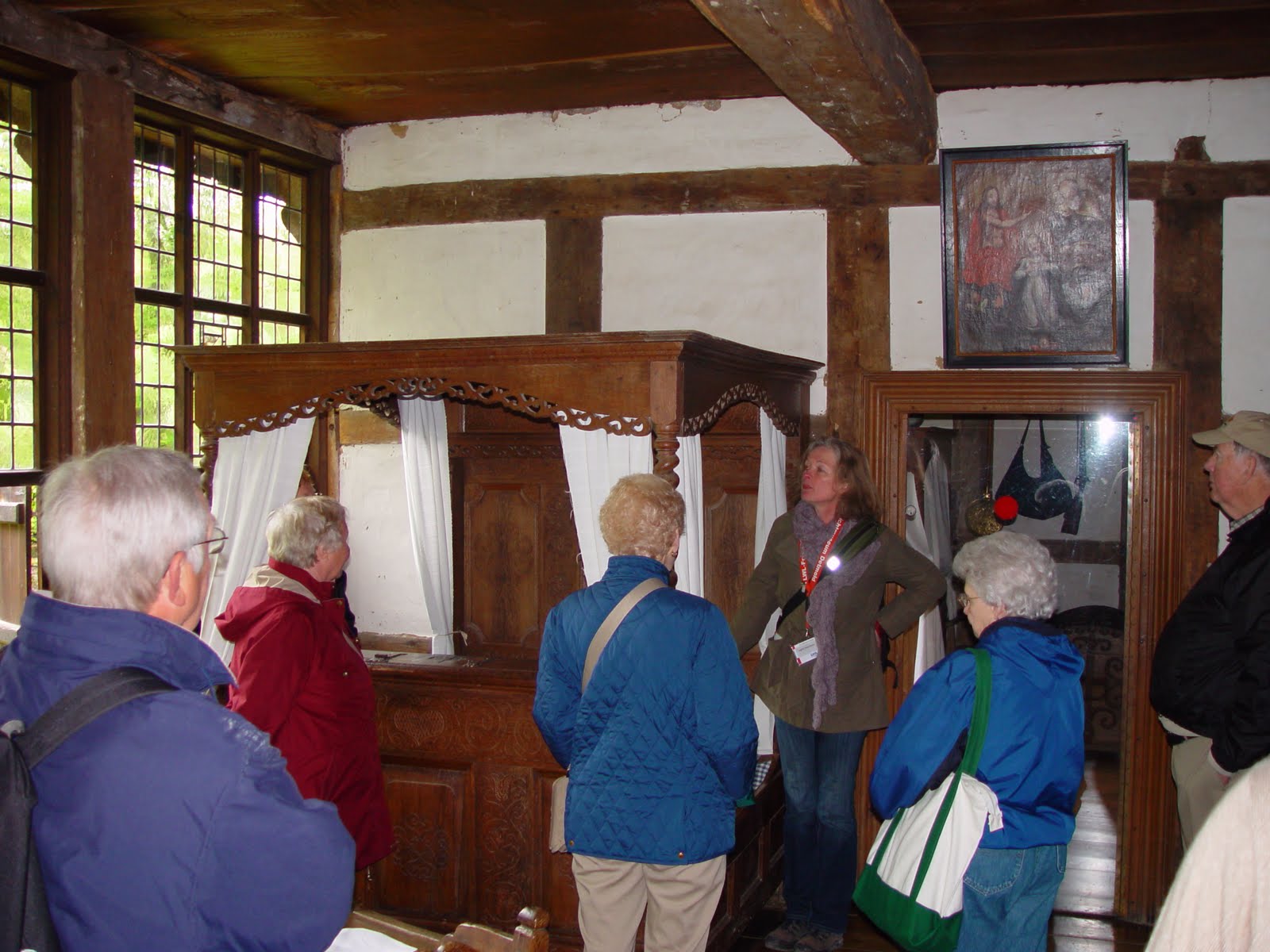
“Geld auf der hohen Kante haben” to have some money put away. Or for rich people they say
“Geld an den Füßen haben” to have money at the foot.
Another interesting thing she told us was when we were out in one of the gardens. Still today they grow things in the gardens that would have been needed on a working farm but we noticed a little shed out past the gardens and asked what that was used for and Ingrid told us that when the farm wife would do the laundry (which we found out wasn’t very often) they would spread the linens out in the field to dry, plus they needed the sun to bleach the linen whiter, someone would need to stay in this house night and day to keep an eye on the linens, so they
 wouldn’t blow away or get stolen. Linen production was a major industry in this part of Germany and most farms used this as additional income in the winter time to supplement their farm income. Most income or production was taxed by the landlord too.
One other thing she told us what about another saying they have in Germany and how it may have got started. The saying is.. “ins Fettnäpfchen treten” Explanation:
In the farmhouses we saw hanging above the fireplace the sausages or other meats that would be smoked from the smoke rising from the fireplace and of course since the majority of these meats was fat, there would be grease or fat falling to the floor. At night or even during the day in the dimly lit house, you would have to be careful not to step in the fat and drag that along the rest of the floor. Sometimes they would put small pots or buckets to catch the fat and now this saying means something like “to blunder or put your foot in your mouth”
These were a few of the interesting stories we learned this day. I will include some pictures and a couple short videos of Ingrid’s talk.
After t
 he Freilichmuseum we headed into Detmold to the Landesarchiv. We had called ahead of time and had things pulled for any of our tour members who would have had towns that would be covered by this Archive. First we had a short overview of the Archives by one of the employees and he was very interesting. He explained the types of things they had there and how they preserve items. My main question to this man was “How can we find out what exactly is available at this archive?” Well, unfortunately they have so much stuff it is not possible to have a complete online catalog. So the best advice I can give you that he gave me is if you know your hometown and know the closest Archive, you can email them with your town’s name and ask what they have for this town. You may be surprised. A couple of our tour m
 embers found out that they had pulled for them the complete Farm Books for some of the Farms that their ancestors had lived on. They were able to request that these books or however many pages they wanted be imaged and sent to them on a CD. Then they can get them translated. I assume that most of the information would be tax lists, or maybe even deaths and who would have next run the farm but we will have to see what all kinds of detail is included in these books. What a find though. So I guess it pays to check with the Archives and see what is available for your town.
 Then we walked through the main pedestrian zone of Detmold and wandered throug
 h the Gardens of the Residence Palace of the Prince of Detmold-Lippe. The Princely Family with Armin Prince zu Lippe as the head of the family, still lives in this palace. After a little while to shop or take pictures we headed to a local restaurant for dinner.
Subscribe to:
Posts (Atom)
